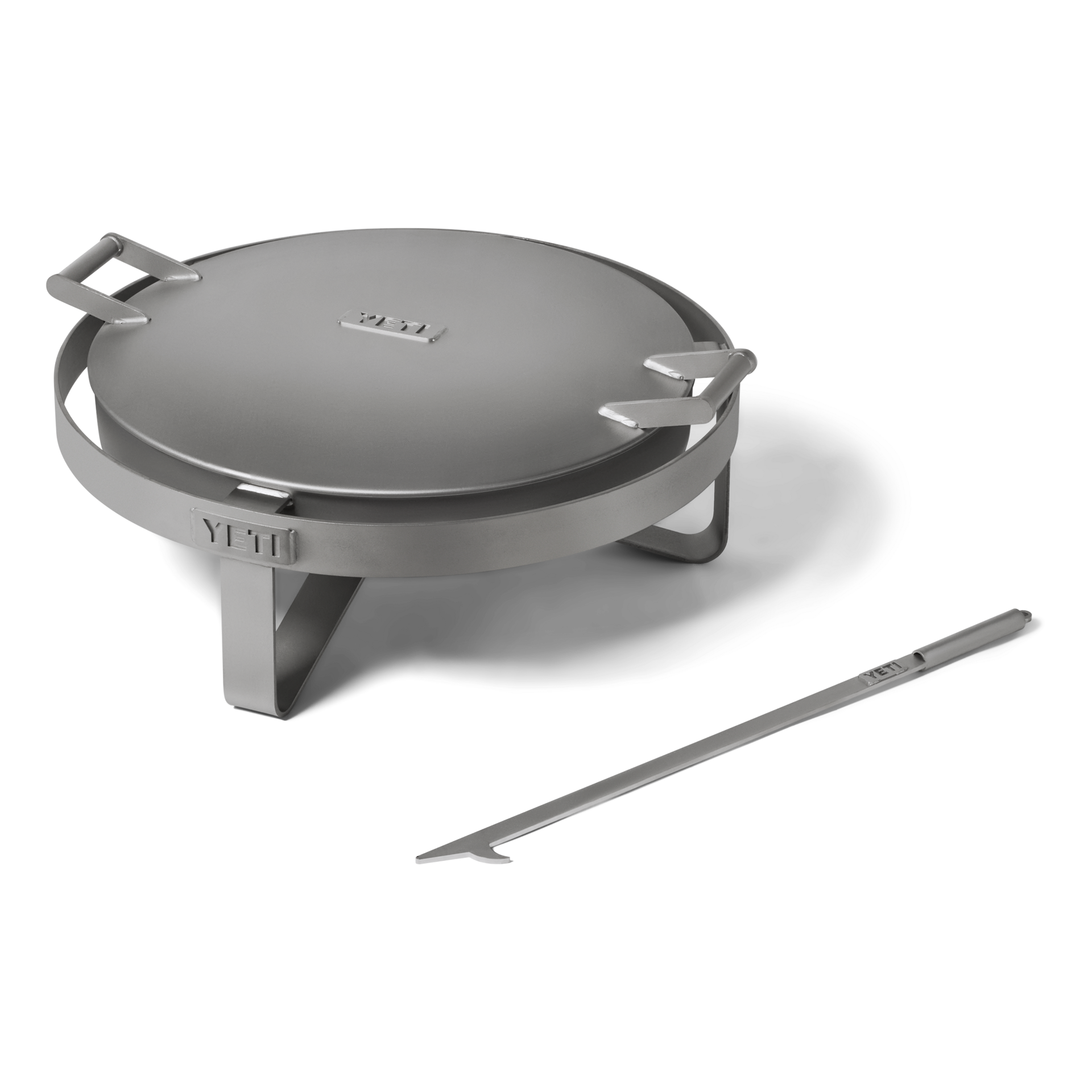
YETI’s first fire pit is a deliberate rejection of the smokeless trend: a shallow, 70-pound corten steel pan, made in Iowa, that trades clean burning for 360 degrees of radiant heat and an open flame you can cook over. Launch coverage praised the build and the honesty of the concept, but be clear about what $1,000 buys: a premium, US-made campfire ring, with real smoke, at nearly triple the list price of a Solo Stove Bonfire. No outlet has published an instrumented test yet, so this verdict leans on the spec sheet, material knowledge, and early community reaction rather than ownership data.
Who it’s for
This pit serves the backyard host, not the camper. A shallow solid-bottom pan radiates heat sideways at the people around it, where double-walled smokeless pits send much of their heat straight up. That is the whole argument, and YETI’s gear lead told Gear Patrol the trade-off was deliberate: “Visibility and access to the fire are things that were important to us.”
The right owner has a permanent spot — stone patio, gravel pad, ranch porch — and plans to leave it there for a decade while the steel turns from blue to bronze. At 70 pounds plus a 15-pound lid, this is not gear you toss in a truck bed every weekend, whatever the Camp tag on YETI’s page implies.
- Backyard hosts who want warmth for a circle of chairs, not a heat column
- Live-fire cooks planning to add the $500 Grill Kit
- Buyers who value US manufacturing and a pit that ages visibly
- Owners with a permanent spot at least 25 feet from structures
- People who like the smell of a real campfire, because they will wear it
Key specs
| Spec |
Detail |
| Price and kit |
$1,000 including corten steel lid (14.8 lb) and fire iron (2.9 lb) |
| Material |
Corten weathering steel; arrives blue, develops a protective bronze patina |
| Size |
31 in outer diameter, 27 in basin, 11 in tall, 6.3 in basin depth |
| Weight |
70 lb pit body, on fixed tripod legs for uneven ground |
| Fuel |
Wood, fitting standard 16 in logs; charcoal when used with the Grill Kit |
| Smoke control |
None — solid-bottom open pan, no secondary combustion |
| Cooking option |
$500 Grill Kit: two case-hardened carbon steel grates, 30.3 x 37.25 in |
| Origin |
Designed in Texas with Mill Scale Metalworks, made in Iowa |
| Warranty |
5 years |
Living with it
The heat pattern is the strongest trait: a 27-inch basin only 6.3 inches deep is closer to a steel campfire ring than to the deep barrels Solo Stove and Breeo sell, and that geometry throws heat laterally at seated guests instead of chimneying it upward. Full 16-inch logs lie flat, the fire stays visible from every seat, and the tripod legs sit steady on uneven ground. CookOut News made the same point at launch: smokeless pits vent heat up; a shallow pan warms the circle better.
The honest caveat: few independent tests exist yet. The pit launched in October 2025 as a limited drop, and ten months later coverage remains launch reporting from GearJunkie, Gear Patrol, and HiConsumption rather than measured head-to-heads. GearJunkie’s Sean McCoy called it more of a pan than a pit and predicted it might run smokier than the competition, with time and testing to tell.
Smoke is the defining daily reality. With no airflow system of any kind, this burns exactly like the campfire it imitates: pleasant with bone-dry hardwood and steady wind, eye-watering with damp logs or swirling gusts. Expect the chair shuffle when the wind shifts, and clothes that smell like the evening. If you bought a Solo Stove to end that ritual, this is a step backward on purpose.
Handling is the second friction. Seventy pounds is a two-person carry over any distance, the lid adds a 14.8 lb plate you will move twice per fire, and the legs do not fold. The lid earns its weight, shielding the basin from rain and snow — standing water is the one thing YETI explicitly warns against.
The patina cycle takes expectation management. The pit arrives as raw blue steel, possibly with manufacturing marks, and develops its bronze protective layer over months of wet-dry cycles. During that period corten typically weeps rust-tinted runoff that can permanently stain concrete and pavers — a known trait of the material, not a YETI defect, but budget for a stone or gravel base.
Cost of ownership
The price is $1,000, sold only through yeti.com and YETI’s own stores, with no visible discounting since launch. The kit is at least complete: the lid and fire iron that rivals sell as $50 to $100 add-ons come in the box, and shipping is free for YETI account holders.
Running costs are analog: no batteries, filters, or firmware, just wood. At typical US bundle prices of $6 to $8, a weekly backyard fire runs very roughly $150 to $300 a year; an open pan has no efficiency tricks to stretch it. Cleanup is a shovel.
The ecosystem is where the bill grows. The Grill Kit costs $500 and the 6-quart Cast Iron Ranch Pan $350, so the full cooking setup YETI photographs is a $1,500 to $1,850 commitment. YETI first shipped the Ranch Pan lidless at $375, then cut the price and refunded early buyers — responsive, but a sign this line is still finding its footing.
The warranty is 5 years — generous for the category, but shorter than the lifetime coverage Solo Stove and Breeo advertise. Corten’s architectural track record suggests the steel will outlast the paperwork if water never pools in it.
Finally, practical constraints: YETI says to place it at least 25 feet from homes and overhead trees, and open wood fires face burn bans, HOA rules, and smoke ordinances that low-smoke pits sometimes skirt. Where open burning is restricted, a smokeless design may be the difference between legal and not.
How it compares
The Solo Stove Bonfire 2.0 lists at $350 and routinely sells for $200 to $270 — roughly a third of the YETI’s price at worst. It is smokeless, 23 pounds, and portable, but concentrates heat upward, takes short logs, and hides the fire behind a rim. It wins on price, smoke, and portability; the YETI wins on group warmth and fire visibility.
The Breeo X24 is the hardest competitor to argue past: $599, USA-made from the same corten steel, smokeless via its X Airflow system, and it cooks with an optional sear plate and outpost grill. It gives up some open-fire ambience and lateral heat, but does most of what the YETI does for $400 less with far less smoke. Only against the 34.5-inch Breeo X30 — $1,399 list, about $1,189 street — does the YETI look reasonably priced, a comparison GearJunkie drew on day one.
The Solo Stove Yukon 2.0 matches the YETI’s 27-inch fire diameter at $550 list, stays smokeless, and weighs around 38 pounds, though the stand costs extra and the heat still rises more than it radiates. The trade is the same everywhere: rivals sell cleaner, cheaper fire; YETI sells a hotter circle, a nicer object, and a brand.
FAQ
How smoky is the YETI Fire Pit really?
As smoky as any open campfire, because that is what it is — no double wall, no secondary combustion. Smoke tracks your fuel: seasoned hardwood burns relatively clean, damp or resinous wood does not. YETI frames this as the price of visibility and lateral heat, so do not buy it expecting Solo Stove behavior.
Can you cook on it, and what does that cost?
Yes, with the separate $500 Grill Kit: a large fixed grate plus a smaller height-adjustable one, both case-hardened carbon steel. YETI recommends wood for ambient fires and charcoal for grilling. Without the kit it is purely an ambient fire pit — though marshmallow sticks are free.
Is the rust normal, and will it stain my patio?
Yes and possibly. Corten arrives as blue steel and is designed to rust into a bronze patina that seals the metal — the feature, not a flaw. Early runoff can stain concrete and pavers, so put it on gravel or stone, use the lid, and never let water sit in the basin.
Bottom line
Buy it if you want a permanent, US-made centerpiece fire that actually warms the whole circle, you plan to cook over real flame with the Grill Kit, and $1,000 reads as furniture rather than gear. The corten build, included lid and iron, and Mill Scale design pedigree are genuine substance under the logo, and nothing mainstream prioritizes radiant heat this openly.
Skip it if smoke, weight, or value tops your list — which covers most buyers. The Breeo X24 delivers USA-made corten plus smokeless burning and built-in cooking for $599, and the Solo Stove Bonfire 2.0 handles casual backyard fires for a quarter of the money. With no independent testing published yet and no discounting in sight, this is a well-built object carrying a steep brand premium: good, with the caveats named above.
Sources and further reading